Wednesday, 12 November 2014

Date Idea - 12/11/2014 - Termas Geometricas, Chile

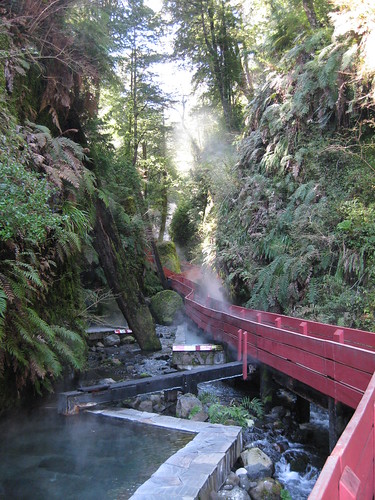
Because you might as well relax and enjoy yourself if you're planning on spending sometime looking at rocks I present: Termas Geometricas near Pucon in Chile. It offers a range of springs in a natural setting (some with waterfalls) for approximately $40 AUD per person. It's on the list!

Image from here - a pretty good website full of things to see and do in Chile.

Wednesday, 5 November 2014

Places I've been: Inverloch Pt 3 - Fossils!

Tiny mammal jaw found at Inverloch - image by Steve Morton (Monash University)

The dinosaur dreaming digsite at Flat Rocks, Inverloch is a rather special as it has yeilded over 10,000 fossils from a time when the rift was developing between Australia and Antarctica. I find one of the most significant to be a tiny mammal jaw (above) which is smaller than a fingernail. It is due to this fossil that all material removed from the fossil rich layer must be broken into sugar cube sized chunks before being assessed for fossil material. 

Map of fossil locations courtsey of the Dinosaur Dreaming website.

The fossils themselves are found in a flood deposit / conglomerate which formed as part of a braided river environment, now called the Strazlecki Group. A large variety of fossils have been found in this region (above) and I'm told the small greyish lump in the photo below is one such fossil fragment.


Also found in this area (but away from the fossil extraction site) are a set of dinosaur footprints. Located on the shore platform, they are slowly erroding and probably won't exist in a couple of years. This year I took a picture with my camera case for scale. The footprints are outlined in a slightly darker sediment and feature two three towed footprints overlaid on each other. The feet themselves are about 1.5x bigger than mine (see my hiking shoe toe for scale as well)


If you want more information about this site, or are interested in joining the team at the dig on their next summer campaign, checkout the dinosaur dreaming website. If you want some awesome pictures of some of the fossils they've recovered, this post  by Tom Rich on The Conversation has some great images.


Monday, 3 November 2014

Counter top geology - Serpentine

I spotted a broken slab of serpentine at the Kilsyth Bargin Centre the other day. It hasn't photographed amazingly well because it's polished but it was a rather nice sample. Not what I'd pick for a bench though, a little soft for longevity.


The broken end showing the polished section (deep green) and the talc-y greasiness of the rock


Saturday, 1 November 2014

Historical places I've been: Tower Hill Maar, Victoria

It's been a while since I've done one of these. This is an image of Jim Driscoll and I at the Tower Hill Maar in Western Victoria, 2013. He's into sedimentology and geothermal research and is just about to finish his PhD at Monash University. For the last couple of years we've assisted with the JMSS geology field trip and this is one of the locations we take the students.
This is a nested maar system is the result of a sequence phreatomagmatic eruptions (note the huge number of layers behind us) resulting in a complex structure seen today. Multiple scoria cones are surrounded by a crater lake (which is probably formed by multiple vents). The countryside around Tower Hill is covered by these ash and scoria layers which all slope gently away from the site of the volcano.The volcano also ejected larger bombs, the impact of one can be seen over my right shoulder. The shape of these craters can help determine the trajectory of the bomb and allows volcanologists to determine the sequence in which the vents were actives.

Wednesday, 29 October 2014

Places I've been: Inverloch Pt 2 - Chrono-turbation


The faulted cliff just to the east of the stairs has some very interesting sedimentary structures, the bulbous shapes in the middle of the above image. Each year, for the benefit of the students, we have a debate over the formation of these features. I tend to fall into the chrono-turbation camp. The basal shape of the structures suggests that the lower, unconsolidated, layer of mud was frozen (permafrost). When it was overlain by a denser mud, it eventually thawed and the heavier mud pushed down into the underlying sediment creating these bulbs.
The other camp is the bio-turbation camp.


If this were bio-turbation the 'burrows' are quite sizeable (digital camera case for scale), so either this is one kick-ass worm-critter, or the smaller dinosaurs were in the habit of digging burrows to a very uniform depth (which could also be explained by permafrost i guess). To me, the lack of fossilised bedding material rules out habitation burrows so if these were burrows they were temporary structures.


This image is of the structures, top down. While there isn't really enough exposure, I feel this looks more like weathered load casts than bio-turbation. I encourage you to visit the shore platform and the cliffs around Inverloch and make your own decision.

Next up: Fossils!
Wednesday, 22 October 2014

Places I've been: Inverloch Pt 1 - Structure

Looking all safe in my super-dooper safety vest!

Last weekend I participated in the annual pilgrimage to Inverloch with the first year geology students. This trip combines everything they've studied this semester into one convenient location - fossils, rock type identification and sedimentary rock naming conventions, sedimentary structures and current indicators and basic structural geology. I'm going to present some of the interesting things spotted at the site in the following posts, for now let's look at my favourite - structural geology!


Normal faulting with massive sandstone on the left and mudstone on the right Fault drag locally bends the beds of the mudstone. Slicken can be seen in the sandstone on the left.

Most of the faulting is this region is normal and associated with the failed rift between Tasmania and Victoria which created the Bass Straight.


Shore platform faulting with fellow demonstrator for scale. A majority of these sedimentary beds are sandstone with occasional zones of scour and fill.  The extent of curvature in the sedimentary beds is more evident on the shore platform than in the cliff face. I've outlined the major faults but this region is riddled with them.


A close up of the faulted sandstone - Stay tuned for Park II - Chrono-turbation!


Bonus image - the demonstrating team from 2010 (Chris, Julie, Roland, Kim and I) with bonus beard, knitted and carpeted by my mother for my birthday, it was COLD that day!

Sunday, 12 October 2014

Science with Amber

Spider in Amber shamelessly linked from here.

My interest in geology started with my Grandfather who still travels to Andamooka to mine opals. He used to go once a year and it was his private time away from his (in my opinion) huge family (5 kids + some ring-ins at times). When I was a child he would occasionally craft jewellery for us from opals or other crystalls that caught his attention. After many years of dabbling at University I finally found the geology department and started my own research. Once facet of this was to research how opals were formed so I could help him (theoretically) stake out his new patch each year.
During this time, he also taught me the basics of silver smithing. This combined with my interest in medieval things led me to play with amber. I recall one of my first attempts went horribly wrong. I had epoxied my cut and polished amber into a setting and chipped the stone while I was tightening the claws. So I thought I'd just dunk it in nail polish remover (like I did opals) to soften the epoxy and recut the stone. (clearly I wasn't thinking). The amber, being a resin, also went soft and squishy. Oops! I have toyed with the idea of seeing if I can soften amber, push inclusions like bugs into it (or squish two pieces together) and then re-harden them but I haven't gotten to that experiment yet.


 One of the experimental amber samples
In summary - I like amber, I like science and the following paper combines the two and may even help me in future purchases. Experimental studies on the heat treatment of Baltic amber. Yamei Wang, Mingxing Yang, and Yiping Yang. Gems & Gemology, Summer 2014, Vol. 50, No. 2