This is a lovely example of a baby Ceratopsian. It is one of a group of herbivore dinosaurs. The best known ones are the Triceratops or other varieties from Mongolia however the earliest ones identified come from Gondwana in the Early Cretaceous. This one was at the Australian Dinosaur exhibit at the Geelong Wool Museum. I had heard that some of the Ceratopsian groups had been amalgamated as scientists determined that their neck frill gets hollow as it grows due to weight requirements so some teenage Ceratopsians had been miss-classified as a separate.
Showing posts with label Museum. Show all posts
Wednesday, 6 April 2016
Wednesday, 9 March 2016
Fossils! - Shrimp
A fossilized shrimp like beastie which is about 150 million years old. Photographed at the Melbourne Museum on the 7/5/2015 by Ant.
Wednesday, 20 January 2016
Countertop geology: Orbicular granite, Boogardie Station, Mt Magnet, Western Australia
Orbicular granite featuring a large vein which has bisected a number of the orbs. The vein in the upper right seems to have experienced a significant level of movement resulting in the offset of a previous creamy coloured up/down vein.
A closer look at the orbs and their growth patterns. SHRIMP U-Pb analysis of the matrix
titanite is 2687 ± 5 Ma (one of the oldest known orbicular granites)
Photos were taken in the Melbourne Museum on the May 7th, 2015 (yes, I know, this post took a while. There's a good reason for that!).
Labels:
Counter top geology,
Granite,
Museum,
Western Australia
Wednesday, 23 December 2015
Fossils - Silurian
Seastars (Salteraster sp) from the Silurian. Recovered from Clonbinane, Victoria. The seastars are approximately 5cm wide. Photographed at the Melbourne Museum on the 7/5/2015 by Ant. There doesn't seem to be a whole lot of biodiversity represented in this rock.
Wednesday, 25 November 2015
Jasperlite from Western Australia
Jasperlite (aka BIF), 2.5 billion years old. Ord Ridley Ranges, Western Australia. Photographed at the Melbourne Museum on the 7/5/2015 by Ant.
Wednesday, 4 November 2015
The Melbourne Museum
A visit to the Melbourne Museum geological section isn't complete without the obligatory 'Help I got eaten by something bitey' picture. I highly recommend checking out the geological history of Victoria section as well as their beautiful rocks and minerals bit. They have some lovely meteorites and ore samples.
Wednesday, 28 October 2015
Australian fossils - Elvisaurus (Cryolophosaurus)
This is part of a travelling fossil-life of Australia exhibit which I managed to catch at the Geelong Wool Mill Museum (of all places). I joined one of Jim and Julies Field Trips and we went and saw these fossils before journeying across the bay to search for fossils in the Inverloch area.
The Crylophosaurus, the first carnivorous dinosaur to be discovered in Antarctica, 190 million years old (Early Jurassic). It has commonly been called the Elvisaurus due to the unique crest on the skull. Photo by Ant.
Wednesday, 23 September 2015
Countertop geology: Tiger eye, Hamersley Range, Western Australia
Some seections of the Marra Mumba tigers eye from Hamersley Range (WGS84
21° 53′ 0″ S, 116° 46′ 0″ E). Photographed on the 7/5/2015 at the Melbourne Museum by Ant.
Saturday, 1 August 2015
On a date with a geologist - Date 4, part 1.
Wall made of local stone at The Cloisters.
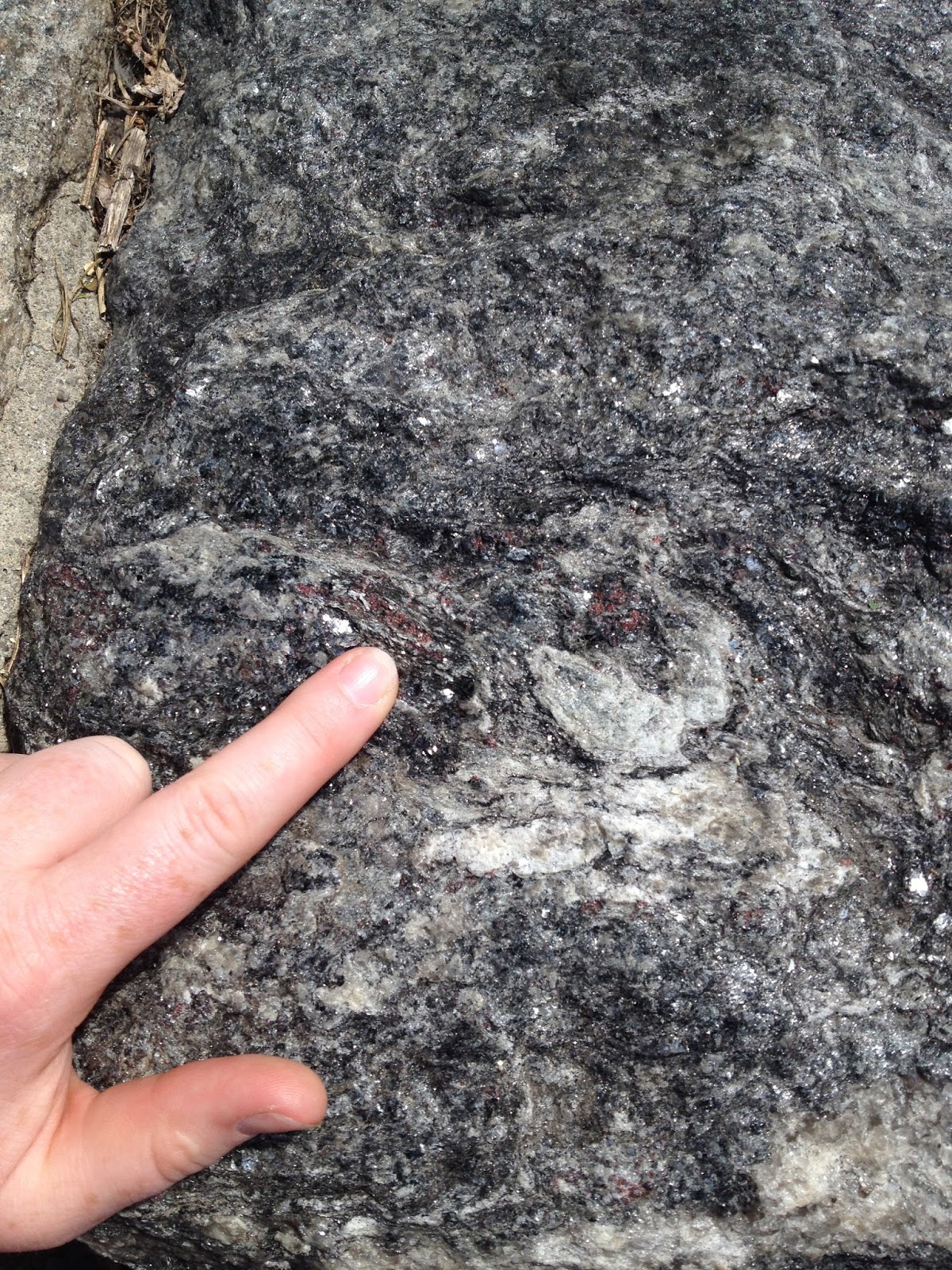
Date four was amazing! We traveled to various locations in Eastern America and saw a lot of rocks. We spent a day checking out The Cloisters, a museum dedicated to Medieval art in New York to satisfy my other interests. The museum overlooks the Hudson River and is composed of three reconstructed cloisters acquired from various areas in Europe as well as a great many artifacts and artworks from the 12th - 15th century. The buildings are based in a beautiful park land and feature both imported and local stone. One of the beautiful rocks used for the carpark walls is a local garnet schist. It has undergone significant metamorphism and shows bands of garnets as well as aluminosilicates.
Garnet in the schists
We did take a moment or two to head out onto a balcony and take some happy snaps of the river, the bridge we crossed onto the island over and of course, each other. Out here we discovered some interesting things.
The river.
Part of The Coisters are clad in micro-granite blocks. I do not know if they are local but given the presence of the schist, it stands to reason there was once a local subduction zone so there should be some local granites forming. Some of these micro-granite blocks feature lovely aplites dykes as pictured below. Aplite is a fine grained intrustive rock composed of quartz and feldspare (thus the pink colour). It is often produced as the final spurt of melt which fills in / takes advantage of small cracks in the rapidly cooling batholith.
Aplite dyke in a micro-granite blocks.
The balcony has also been crafted of local stone and displays a rather lovely meta-psammo-pelite aka gneiss. Below is a photograph of a rather lovely specimen showing dark and light banding.
Labels:
Aluminosilicates,
Aplite,
Date,
Dyke,
Granite,
Metamorphics,
Museum,
New York,
Pelite,
Sediments,
USA
Subscribe to:
Posts (Atom)
.jpg)

.jpg)
.jpg)
.jpg)