
Showing posts with label Fossils. Show all posts
Showing posts with label Fossils. Show all posts
Sunday, 11 June 2017
Fossils at Naracoorte.
A huge shell fossil from the Naracoorte member of the Gambier Limestone. This limestone formed in a shallow temperate sea. The environment appears to have pretty low biodiversity as evidenced by the small variety of fossils preserved in the rock. This large shell is unusual as the Gambier Limestone seems to be dominated by sea urchin flukes and spines.


Wednesday, 5 October 2016
Fossils - Pecten fossil

Pecten from the Naracoorte Limestone - photographed with an iphone through a 10x hand lense.
This tiny tiny shell was found by one of my students from JMSS while we were doing a palaeontology practical exercise at the Naracoorte Caves. He was sorting through some cave sediments which has been retrieved from a cavity found in a nearby quarry. Due to the nature of the discovery, dating these items through stratification was impossible, so they have been used to give the location an assemblage database and are used to educate school groups. Most of the fossils come from small mammals and reptiles with the occasional Megafauna bone or tooth as well. The cave fossils are less than half a million years old.
This pecten comes from the Naracoorte Limestone, which is a member of the Mt Gambier Limestone Formation. The MtG has been dated to between 24 - 33 million years old. It's amazing to think this pecten is still is almost perfect condition and has survived this long!
Wednesday, 7 September 2016
Fossil tree - Inverloch, Victoria

Cliff panorama showing a fossilised tree stump in-situ in the center left.

Close up of the tree showing bedding of sands above and below it. All beds tilt approximately 10 degrees to the East.

Zoom in of the stump showing the roots still twining through the now lithified sediments. Floods can do some amazing things and it's pretty awesome that this tree has been preserved like this!
Wednesday, 27 July 2016
Fossil leaf - Sydney Basin sediments

A fossil leaf in a core section (rare) from the Sydney Basin. Section provided by J.Driscol of Monash University.
Wednesday, 13 July 2016
Fossil wood - Inverloch, Victoria
Every time I go to Inverloch to teach (over 30 times!) I find something new to investigate.


This is a piece of fossilised wood. Not so unusual given these rocks are terrestrial basin deposits generally associated with periodic flooding. As a result, they contain a lot of coal and the occasional fossilised tree bit. This one caught Jackson van der Hove's eye because it's got a perfect little wood knot preserved in it. How awesome is that?!
Wednesday, 15 June 2016
Fossil leaves - Illawarra coal measure, New South Wales

Both of these images are leaf fossils from the Illawarra coal measures in New South Wales. They have been dated to the Permian! They were provided by Dr C. Mays as teaching samples for a class I assisted teaching at Monash University and I couldn't resist snapping a few photos. They're lovely examples of preservation.

Wednesday, 4 May 2016
Random Fossils
Random fossils spotted on a co-workers desk at Monash University. I have no idea where they are from but they're lovely!


Urchin and coral polyp? fossils spotted on co-workers desk at Monash Uni, photo by Ant.
Wednesday, 6 April 2016
Fossils - Ceratopsian
This is a lovely example of a baby Ceratopsian. It is one of a group of herbivore dinosaurs. The best known ones are the Triceratops or other varieties from Mongolia however the earliest ones identified come from Gondwana in the Early Cretaceous. This one was at the Australian Dinosaur exhibit at the Geelong Wool Museum. I had heard that some of the Ceratopsian groups had been amalgamated as scientists determined that their neck frill gets hollow as it grows due to weight requirements so some teenage Ceratopsians had been miss-classified as a separate.
 Baby Ceratopsian, photo by Ant.
Wednesday, 9 March 2016
Fossils! - Shrimp

A fossilized shrimp like beastie which is about 150 million years old. Photographed at the Melbourne Museum on the 7/5/2015 by Ant.
Wednesday, 23 December 2015
Fossils - Silurian

Seastars (Salteraster sp) from the Silurian. Recovered from Clonbinane, Victoria. The seastars are approximately 5cm wide. Photographed at the Melbourne Museum on the 7/5/2015 by Ant. There doesn't seem to be a whole lot of biodiversity represented in this rock.
Wednesday, 9 December 2015
Places I've been: Eric the Red, Otway Basin, Victoria

The anchor of Eric the Red, a ship that sank in 1880. The local council periodically cements the anchor back down as the erosive action of the waves on the shore platform frees it.
The anchor is located near the Eric the Crawfish dinosaur dig site. The dig is organised by Museum Victoria. It operates for one month in Summer and typically consists of 12-18 volunteers and Museum staff. This dig is the partner to the Dinosaur Dreaming dig on Flat Rocks, Inverloch. The sediments here are 120 million year old feldspathic sandstone with scour structures that are filled with mudstone ripup clasts and coal deposits. The depositional environment was a broad river that took advantage of the emerging East-West rift valley as Australia and Antartica started to break apart. Many notable dinosaur fossils have been found at these sites.
Wednesday, 28 October 2015
Australian fossils - Elvisaurus (Cryolophosaurus)
This is part of a travelling fossil-life of Australia exhibit which I managed to catch at the Geelong Wool Mill Museum (of all places). I joined one of Jim and Julies Field Trips and we went and saw these fossils before journeying across the bay to search for fossils in the Inverloch area.

The Crylophosaurus, the first carnivorous dinosaur to be discovered in Antarctica, 190 million years old (Early Jurassic). It has commonly been called the Elvisaurus due to the unique crest on the skull. Photo by Ant.
Wednesday, 27 May 2015
Pseudofossils - 12 Apostles, Victoria
I spotted some beautiful faux fossils in the sandy-limestone used to make the underpass at the 12 Apostles while I was there with the JMSS geology class a month ago. These dendritic patterns are formed by the deposition of minerals by hydrothermal fluids. They are often mistaken for plant fossils by the geologically-uneducated. Still, they're quite pretty.

Sandy-limestone? in the underpass at the 12 Apostles, Victoria.
Wednesday, 24 December 2014
Places I've been - Jan Juc Marl, Otway Basin
Bioturbation // burrows in the Jan Juc Marl. A marl is a calcium rich mud and the Jan Juc Marl is early Ogliocene - early Miocene in age and is defined as a fine-grained silty glauconitic marl with sandy calcarenite interbeds which coarsens upwards.

My learned friend, Shannon Hurley, suggests these overlapping and diverging burrows are Chondrites. She proposed that the circular burrow (cross-section) pictured below my finger is Thalassinoides.

Ophiomorpha?
Wednesday, 5 November 2014
Places I've been: Inverloch Pt 3 - Fossils!

Tiny mammal jaw found at Inverloch - image by Steve Morton (Monash University)
The dinosaur dreaming digsite at Flat Rocks, Inverloch is a rather special as it has yeilded over 10,000 fossils from a time when the rift was developing between Australia and Antarctica. I find one of the most significant to be a tiny mammal jaw (above) which is smaller than a fingernail. It is due to this fossil that all material removed from the fossil rich layer must be broken into sugar cube sized chunks before being assessed for fossil material.

Map of fossil locations courtsey of the Dinosaur Dreaming website.
The fossils themselves are found in a flood deposit / conglomerate which formed as part of a braided river environment, now called the Strazlecki Group. A large variety of fossils have been found in this region (above) and I'm told the small greyish lump in the photo below is one such fossil fragment.

Also found in this area (but away from the fossil extraction site) are a set of dinosaur footprints. Located on the shore platform, they are slowly erroding and probably won't exist in a couple of years. This year I took a picture with my camera case for scale. The footprints are outlined in a slightly darker sediment and feature two three towed footprints overlaid on each other. The feet themselves are about 1.5x bigger than mine (see my hiking shoe toe for scale as well)

If you want more information about this site, or are interested in joining the team at the dig on their next summer campaign, checkout the dinosaur dreaming website. If you want some awesome pictures of some of the fossils they've recovered, this post by Tom Rich on The Conversation has some great images.
Wednesday, 27 August 2014
Date idea 27/8/2014 - Petrified Forest
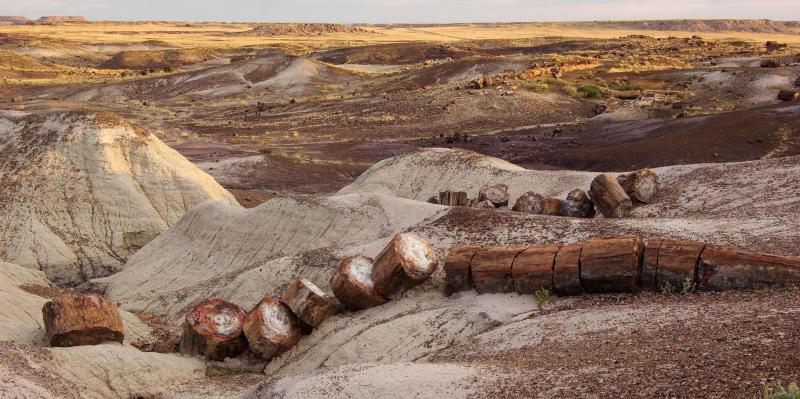
I've spent some time teaching at the Fossilised Forest on the shore platform at Inverloch, Victoria. It's quite a sight to see huge tree trunks that have been knocked over in a flooding event and preserved with the mud still clinging to the rocks. I've recently found out about an even more impressive fossilized trees - The Arizona Petrified Forest (http://www.nps.gov/pefo/index.htm). Not only does this place have a forest of preserved trees, it also has some amazing fossils too.

Subscribe to:
Posts (Atom)