Bubble trails in basalt on the ATO building on Collins Street, Melbourne. I like the sections in the upper left where there are sections with differently sized bubbles. I'd suggest these were busy cooling before being pried away from the rest of the block by locally increased degassing.
Showing posts with label Counter top geology. Show all posts
Wednesday, 29 June 2016
Wednesday, 20 January 2016
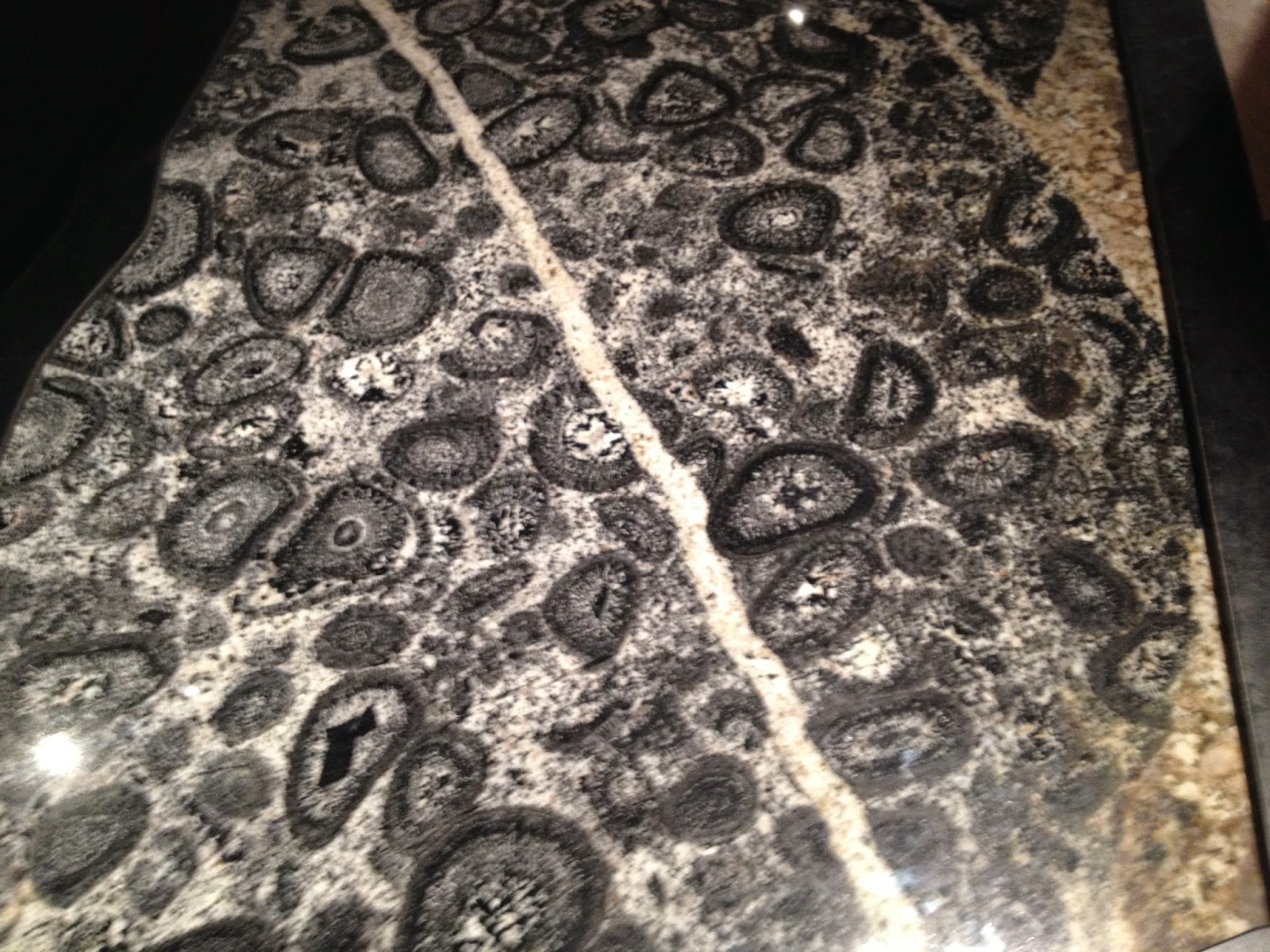
Countertop geology: Orbicular granite, Boogardie Station, Mt Magnet, Western Australia
Orbicular granite featuring a large vein which has bisected a number of the orbs. The vein in the upper right seems to have experienced a significant level of movement resulting in the offset of a previous creamy coloured up/down vein.
A closer look at the orbs and their growth patterns. SHRIMP U-Pb analysis of the matrix
titanite is 2687 ± 5 Ma (one of the oldest known orbicular granites)
Photos were taken in the Melbourne Museum on the May 7th, 2015 (yes, I know, this post took a while. There's a good reason for that!).
Labels:
Counter top geology,
Granite,
Museum,
Western Australia
Friday, 1 January 2016
A new year of geology
Happy new year all! I thought I'd kick the new year off with some sedimentary structures in honour of my newly doctorised friend Jim. Jim studied the sedimentary rocks of Northern Tasmania which formed before the development of plant life. Jim and Mazey combined forces to foster my appreciation of all things sedimentary.
The sedimentary structures on the right of the above image are slump features, specifically load casts and associated flame structures. They form when denser/courser material is dumped into unconsolidated fine grain sediment. In this case, medium grain sand being deposited on top of fine grain sand,. The orientation of the flame structures indicates that younging is toward the right of the above picture. All following pictures have been rotated to show younging in the upward (ish) direction.
I spotted these features while capturing Ingress portals in Perth. They are located on the holocost memorial in one of Perth's lovely parks on the corner of St Georges Terrace and Barrack Street (-31.955992, 115.859792). I do not know the origin of the sandstone that forms the memorial so if any of you do, drop a comment below and educate us all!
Load cast - note the courser (visible) grains and the rounded shape.
Flame structure - as the load plops downward the finer matter is pushed upward into the 'neck' between the loads. A flame can often indicate the direction of flow as the tail will point to where the load has come from. Given the 3D nature of these structures, it is important to look at all sides if possible to determine the direction of flow as accurately as possible.
This picture is taken near to the base of the memorial (younging to the right). It is easy to see multiple flames and a jumble of casts. Given the chaotic nature of the casts, it is possible that these structures weren't caused by sedimentary transport but were caused by liquifaction. This process occurs where the finer sediments in unconsolidated horizons are vibrated by a localised earthquake. The fine sediments start to migrate upwards allowing the heaver sediments to drop. A recent example of this phenomena is the 2011 Christchurch earthquake. Large sections of the city were built on river sediments and the liquifaction caused by the series of earthquakes caused some cars to sink over a meter and undermined many buildings.
Labels:
Christchurch,
Counter top geology,
Earthquake,
Memorial,
Perth,
Sandstone,
Sediments
Wednesday, 26 August 2015
Countertop geology - Sheared spashback
This lovely rock has been used as the splashback for my friends kitchen. It was sold to her as 'black granite' but you and I know there is no such thing.
A closer inspection shows that the white veins are composed of feldspars while the darker matrix contains a significant amount of greyish quartz. The rock has undergone a significant amount of stress as shown by the sigmoidal shape of the feldspar vein in the image above. I'd love to get my hands on a raw edge of this rock, or perhaps see it in strong sunlight so I can determine the composition better. It is however, a lovely rock.
Wednesday, 8 July 2015
Countertop geology: sheared granite
Today's countertop geology was brought to you by friends in Queensland. They have the most lovely granite table on their verandah and the fed me delicious Canadian breakfast foods while I took these photos.
This granite has been sheared and the phenocrysts are surrounded by almost sigma-shaped matrix. The picture below shows a grain that is probably at right angles to shear direction and as such hasn't rotated like some of the others.
Wednesday, 4 February 2015
Counter top geology: 4/2/2015 - Galaxy 'granite', Andhra Pradesh, India
Galaxy Granite is mined in various places in India such as Chimakurthi. Though it is marketed under the term 'granite' because it is hard and dark it is actually Gabbro. Light coloured and soft rocks are almost always marketed under the term Marble. The Galaxy Granite is unusual because it contains small crystals of bronzite which give it a bright sparkly effect and as such is occasionally marketed as Star Granite. Massive shout out to Wendy Kirt and David Cook who published Graveyard Geology. It isn't amazing in a photograph but would like great as a counter or some other decorative stone.
Photo from Stone Network.
Wednesday, 14 January 2015
Counter top geology: Verde Smeraldo
Countertop geology - as a quartzite, this would make a lovely countertop. The high silicon content would result in a strong surface that doesn't scratch easily and retains it's lustre.
Verde Smeraldo - Green Quartzite from Bahia, Brazil. Image from quarry owner here.
Wednesday, 10 December 2014
Date Ideas: 10/12/2014 - Azul Macaubas quarry, Brazil (counter top geology)
I haven't seen this rock in person but the images I've found on the web make it a must see / must have. It seems to be a quartzite with a delicate blue colour introduced by dumortierite. The website that sells it is flash so not so good for getting images from however you should have a flick through their page (clunky though it is) - here. This is sold as Azul Macaubas, or sometimes Blue Marble. It looks best as large pieces such as bench tops. I think I need a bath made out of this, or a swimming pool maybe. Tiles would work beautifully as well.
I got the below image from here, and my structural geology brain went wow - look at those refolded folds!
Labels:
azul macaubas,
Brazil,
Counter top geology,
Date idea
Monday, 3 November 2014
Counter top geology - Serpentine
I spotted a broken slab of serpentine at the Kilsyth Bargin Centre the other day. It hasn't photographed amazingly well because it's polished but it was a rather nice sample. Not what I'd pick for a bench though, a little soft for longevity.
The broken end showing the polished section (deep green) and the talc-y greasiness of the rock
Wednesday, 1 October 2014
Counter top geology - Rapakivi granite
Large (up to 6cm) circular orthoclase feldspars (pink) phenocrysts with growth rings of opaque minerals (hornblende?). Many of the feldspars have a plagioclase feldspar (green) rim. Some also display a growth ring of plagioclase. The rest of the granite consists of large (1cm) crystals of dark minerals and orthoclase.
Small growth rim of plagioclase suggests alternating temperature/chemistry of the melt?
This granite is located on the side of Bran Diamonds on Swanston Street, Melbourne. It's one of my favourite facias in the city. I always thought it was a lovely weathered example of orbituclar granite however when confirming it's origin I found this page and this page both of which suggest this is in fact Rapakivi Granite.
Subscribe to:
Posts (Atom)