Wednesday, 14 October 2015

Places I've been: Blue Lake, Mount Gambier, South Australia


The most recent field camp took me to the Mt Gambier marr complex along the limestone coast. Mt Gambier's marr complex consists of four (or more) craters, two of which are now above the water table. The largest, Blue Lake, is approximately 70m deep and houses the towns water supply. The local aquifer is composed of limestone, and needless to say, the local population has a minor calcite scale issue inside their pipes. During Summer, the Blue Lake turns a vibrant blue as the warmer water contains more micro-crystals of calcite which reflect the blue wavelength. Mt Gambier is part of the Australia's Newer Volcanics which extends from Mt Gambier to the CBD of Melbourne. The Newer Volcanics is composed of 437 volcanoes (the awesome Dr Julie Boyce counted them!) and the most recently dated eruption is Mt Shank, about 10 minutes south of Mt Gambier.

As I as there after summer, the water had returned to it's typical slate blue/grey colour.

I've always wondered if this is a fault where you can see the offset between the limestone, basalt and ash layers. This may also be an optical illusion created by a cove. Someday I'll get to the other side of the lake and check it out.

Wednesday, 23 September 2015

Countertop geology: Tiger eye, Hamersley Range, Western Australia

Some seections of the Marra Mumba tigers eye from Hamersley Range (WGS84 21° 53′ 0″ S, 116° 46′ 0″ E). Photographed on the 7/5/2015 at the Melbourne Museum by Ant.


Thursday, 10 September 2015

Geology around town - Basalts at Southern Cross Station, Melbourne, Aus

This is a picture of something residents of Melbourne take pretty much for granted - basalt pavers. They're everywhere, we've used them in to make gutters, pave the city and build old churches and public buildings. Why you ask? Do the people of Melbourne like having a grey city or do the architects have something about igneous rocks? Nope, we've used them because there are 437 volcanoes (at last count - thanks Dr Julie Boyce!) between the CBD of Melbourne and Mt Gambier in Souther Australia. These have provided a plentiful supply of basalt which is both easy to access and a reasonably good building material (compared to limestone).
As a result, we as Melbournians, see it everywhere. Recently, the Melbourne City council decided it wanted to replicate the 'laneway' feel of the city so many internal walking zones have been paved with this stuff too.
The bubble trails in the basalt give them texture and visual interest. By looking at the bubbles you can often tell which way they were traveling and thus which side is 'up'. The gas bubbles are created when volitiles in the magma are able to exsolve due to the decrease in pressure as the magma rises to the surface. The gas bubbles then move to the surface of the magma but quick cooling will often trap some of the bubbles leaving these delightful trails behind. If you look at the bubbles they will often have a hot-balloon shape. The thin part of the bubble points to the direction it came from where the top of the balloon heads towards the area of least pressure (i.e. the top of the lava). In the image above I spotted three balloon shaped bubbles but as they are in the minority, and point in three different directions I'm of the opinion that this bubble trail was actually rising towards the viewer.

Photos taken at Southern Cross Station, Melbourne on the 2nd of September 2015 with an Iphone 4.


Wednesday, 26 August 2015

Countertop geology - Sheared spashback

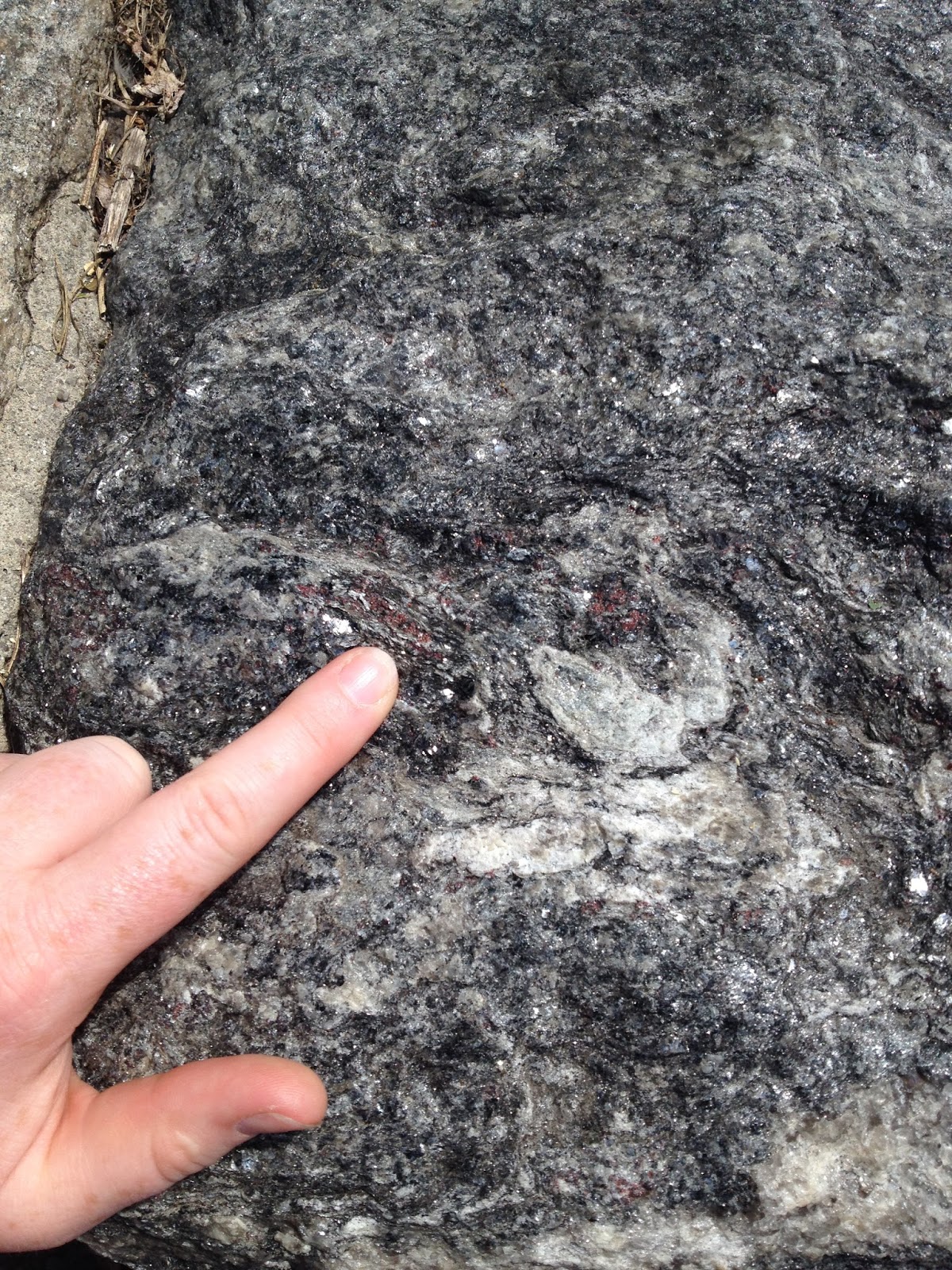
This lovely rock has been used as the splashback for my friends kitchen. It was sold to her as 'black granite' but you and I know there is no such thing.


A closer inspection shows that the white veins are composed of feldspars while the darker matrix contains a significant amount of greyish quartz. The rock has undergone a significant amount of stress as shown by the sigmoidal shape of the feldspar vein in the image above. I'd love to get my hands on a raw edge of this rock, or perhaps see it in strong sunlight so I can determine the composition better. It is however, a lovely rock.

Wednesday, 12 August 2015

Sedimentology!

Sedimentology - the quartz rich sands of a beach near San Remo

Saturday, 1 August 2015

On a date with a geologist - Date 4, part 1.

Wall made of local stone at The Cloisters. 

Date four was amazing! We traveled to various locations in Eastern America and saw a lot of rocks. We spent a day checking out The Cloisters, a museum dedicated to Medieval art in New York to satisfy my other interests. The museum overlooks the Hudson River and is composed of three reconstructed cloisters acquired from various areas in Europe as well as a great many artifacts and artworks from the 12th - 15th century. The buildings are based in a beautiful park land and feature both imported and local stone. One of the beautiful rocks used for the carpark walls is a local garnet schist. It has undergone significant metamorphism and shows bands of garnets as well as aluminosilicates.

Garnet in the schists

We did take a moment or two to head out onto a balcony and take some happy snaps of the river, the bridge we crossed onto the island over and of course, each other. Out here we discovered some interesting things.

The river.

Part of The Coisters are clad in micro-granite blocks. I do not know if they are local but given the presence of the schist, it stands to reason there was once a local subduction zone so there should be some local granites forming. Some of these micro-granite blocks feature lovely aplites dykes as pictured below. Aplite is a fine grained intrustive rock composed of quartz and feldspare (thus the pink colour). It is often produced as the final spurt of melt which fills in / takes advantage of small cracks in the rapidly cooling batholith.

Aplite dyke in a micro-granite blocks.

The balcony has also been crafted of local stone and displays a rather lovely meta-psammo-pelite aka gneiss. Below is a photograph of a rather lovely specimen showing dark and light banding.


Wednesday, 22 July 2015

Geology around town: Flinders St Station, Victoria, Australia

Flinders Street Station, with an iconic Melbourne tram.

During a recent trip to the city of Melbourne I spent some time admiring the granites at Flinders Street Station. The granites most likely originate from the Harcourt Granite, located near Castlemaine, Victoria. They are a lovely creamy colour, course grained and feature a number of xenoliths and enclaves.
A xenolith, hornfels (with remnant bedding?)

An enclave featuring large K-feldspars located under the ticker sellers window.

Under the clocks to the right this xenolith is halfway up a pillar.